


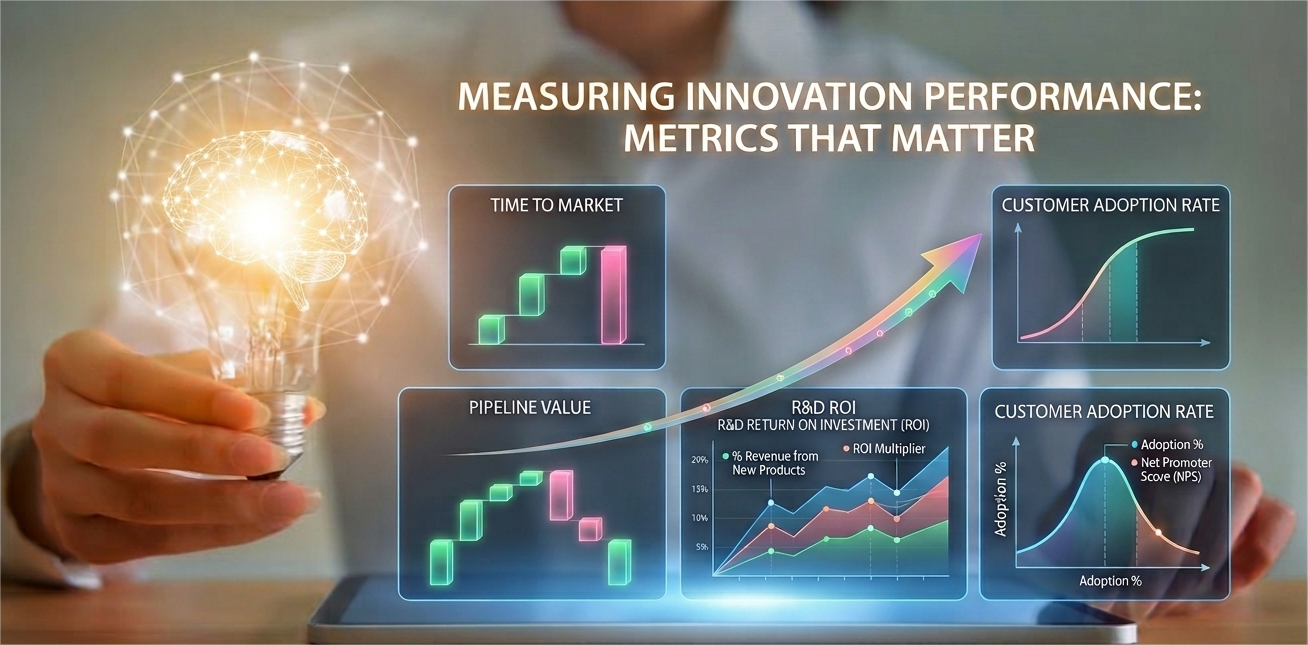
Measuring Innovation Performance: Metrics That Matter
Why Measuring Innovation Matters
Without clear metrics, innovation can become unstructured and ineffective. Tracking performance allows organizations to:
-
Evaluate Impact: Understand which initiatives deliver real value.
-
Optimize Resources: Allocate time and budget effectively.
-
Reduce Risk: Use data to validate ideas before scaling.
-
Drive Accountability: Ensure teams stay aligned with innovation goals.
Key Categories of Innovation Metrics
To measure innovation effectively, organizations should focus on a balanced set of metrics across different categories:
1. Input Metrics (What You Invest)
These metrics track the resources dedicated to innovation:
-
R&D spending as a percentage of revenue
-
Number of employees involved in innovation projects
-
Investment in training and innovation tools
Input metrics show commitment to innovation, but they don’t guarantee results on their own.
2. Process Metrics (How You Innovate)
Process metrics evaluate the efficiency and effectiveness of innovation activities:
-
Number of ideas generated
-
Idea-to-implementation conversion rate
-
Time to market for new products or services
-
Number of experiments or prototypes tested
These metrics help organizations identify bottlenecks and improve workflows.
3. Output Metrics (What You Deliver)
Output metrics focus on the tangible results of innovation efforts:
-
Number of new products or services launched
-
Patents filed or intellectual property created
-
Percentage of revenue from new offerings
-
Customer adoption rates
They provide insight into how innovation translates into market-ready solutions.
4. Outcome Metrics (Business Impact)
Outcome metrics measure the long-term impact of innovation on business performance:
-
Revenue growth driven by innovation
-
Market share increase
-
Customer satisfaction and retention
-
Cost savings from process improvements
These are the most critical metrics, as they demonstrate real business value.
Leading vs. Lagging Indicators
A strong innovation measurement framework includes both:
-
Leading Indicators: Predict future success (e.g., number of ideas, R&D investment).
-
Lagging Indicators: Reflect past performance (e.g., revenue from new products).
Balancing both ensures organizations can track progress while anticipating future outcomes.
Real-World Examples
Companies that excel at measuring innovation performance include:
-
Amazon tracks customer-centric metrics and continuously experiments to improve services and products.
-
3M Company uses innovation metrics like the percentage of revenue from new products to sustain growth.
These organizations demonstrate how data-driven innovation leads to consistent success.
Best Practices for Measuring Innovation
-
Align Metrics with Strategy
Ensure your innovation metrics directly support your organization’s goals and priorities. -
Keep It Balanced
Use a mix of input, process, output, and outcome metrics to get a holistic view. -
Focus on Actionable Insights
Choose metrics that provide clear guidance for decision-making and improvement. -
Leverage Technology
Use analytics tools and dashboards to track performance in real time. -
Continuously Refine Metrics
Innovation evolves, so your measurement framework should adapt over time.
Common Pitfalls to Avoid
-
Measuring Only Outputs: Ignoring inputs and processes can limit improvement.
-
Overloading with Metrics: Too many KPIs can create confusion and reduce focus.
-
Lack of Alignment: Metrics that don’t connect to business goals provide little value.
-
Ignoring Culture: Innovation success also depends on employee engagement and mindset.
Conclusion
Measuring innovation performance is essential for turning ideas into sustainable business success. By focusing on the right metrics—across inputs, processes, outputs, and outcomes—organizations can track progress, optimize strategies, and maximize impact.
In today’s data-driven world, businesses that measure innovation effectively are better equipped to adapt, compete, and lead in an ever-changing landscape.


GInI is the world’s leading professional certification, business accreditation, and membership association in the field of innovation.
Get the latest resources, news and more.
Professional Certifications
CInP® - Certified Innovation Professional
CDTP® - Certified Design Thinking Professional
CInS® - Certified Innovation Strategist
CCInO® - Certified Chief Innovation Officer
AInA® - Authorized Innovation Assessor
CInA® - Certified Innovation Associate
AGVA® - Authorized Growth Venture Assessor
CFSP® - Certified Future Shaping Professional
Business Accreditations
CInOrg® - Certified Innovative Organization
CGInO® - Certified Government Innovative Organization
CInU® - Certified Innovative University
CInGV® - Certified Innovative Growth Venture
AInL® - Accredited Innovation Lab
ABI® - Accredited Business Incubator
AAP® - Accredited Accelerator Program
AInTP® - Accredited Innovation Training Program
AInEP® - Accredited Innovation Education Program
InE® - Innovation Endorsement
CFSOrg® - Certified Future Shaping Organization